 minute read
This page describes how to manage spend and its distribution within placements.
Publishers can set budget caps and pacing on their placements. These settings limit spend or impressions and pace all deals associated with a specific placement.
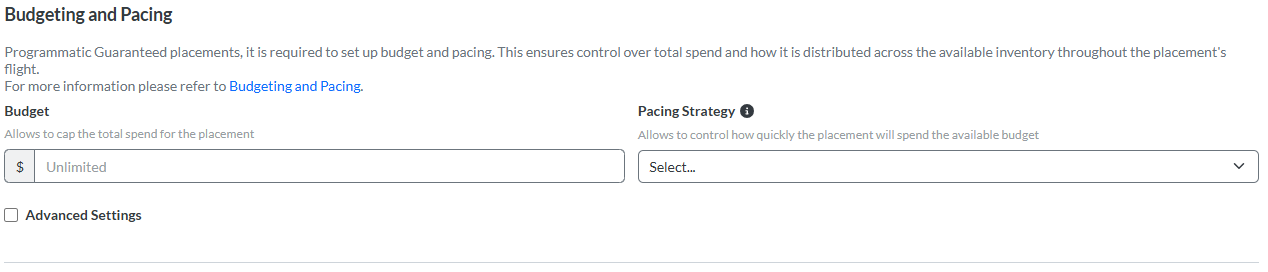
Budget
Budget allows you to control the total spend for a specific placement (for example, spend up to $50,000 for this placement). By default, the system applies an Unlimited cap to every new placement. Under this setting, the system does not restrict spend.
This is a common scenario for PMP An invitation-only auction where premium publishers sell their ad space to a select group of advertisers. deals, where budgeting and pacing are managed within a DSP.
Pacing Strategy
Pacing Strategy allows you to determine how quickly a placement will spend its allocated budget. You must define a total budget for a placement before the system allows you to select a pacing strategy.
| Pacing Strategy | System Behavior |
|---|---|
| ASAP |
Place Exchange spends the allocated budget as quickly as possible. Select this strategy in the following circumstances:
|
| EVEN | Place Exchange limits spend to distribute the remaining budget evenly across the remaining duration of the campaign. When delivery deviates from target, the system recalculates the daily spend target to absorb over- or under-delivery gradually across future days, without pausing spend. This results in smoother, continuous delivery adjustments. |
| EVEN_ASAP_CATCHUP |
(DEFAULT) Place Exchange targets a constant daily spend by distributing the total budget equally across the entire campaign duration.
|
Example:
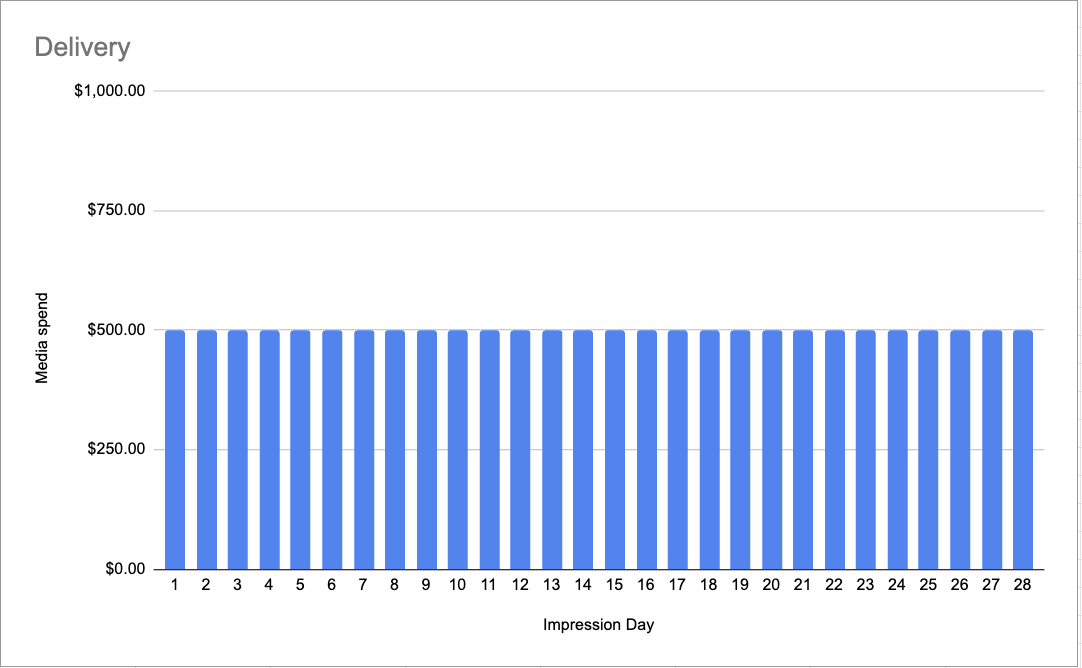
For a 4-week placement flight with a $14,000 budget and generally ample inventory availability, the campaign will be paced evenly:
- Day 1-28 will see a spend of $500 per day ($14,000 / 28 days = $500) — this represents normal daily delivery.
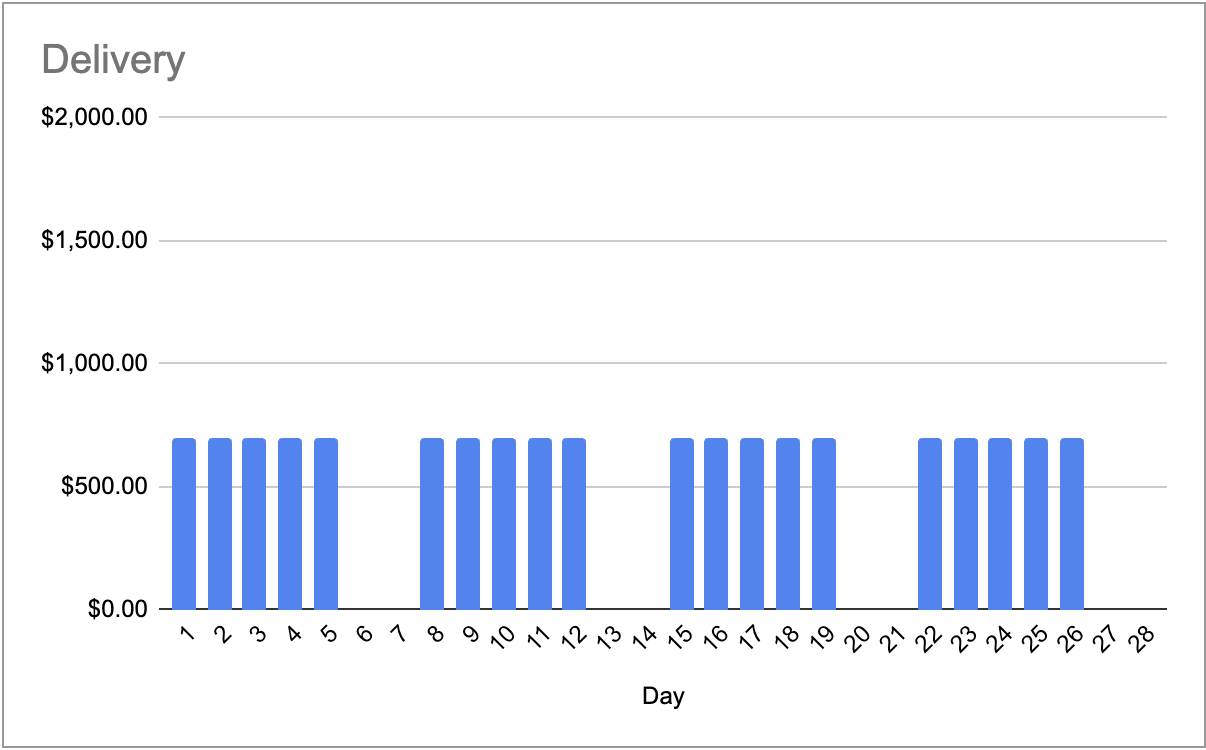
If a placement uses dayparting, the algorithm will respect it.
Example:
For a 4-week placement flight with a $14,000 budget, scheduled to run Monday to Friday from 10 AM to 2 PM, and with generally ample inventory availability, the campaign will be paced evenly across active hours:
- Day 1-5, Day 8-12, Day 15-19, and Day 22-26: Spend will be $700 ($14,000 / 80 hours * 4 hours per day) — this represents normal daily delivery.
- Saturday-Sunday (Day 6-7, Day 13-14, Day 20-21, and Day 27-28): The campaign will not spend during these days as it is not active.
Place Exchange offers a range of settings to fine-tune behavior for various situations.

Daily Caps
(Defaults to unlimited) The Daily Cap setting restricts the amount a placement can spend within a single 24-hour window.
In most scenarios, you should set the daily cap significantly higher than your expected daily spend. This overhead allows the placement to "catch up" and recover lost volume if it previously under-delivered. The system calculates daily caps based on a unique cycle: 12:00 PM (Noon) to 11:59 AM UTC.
The Budget and Daily Cap figures represent targets and can overspend depending on how high play latency is.
For example, if play latency is 5 minutes, and spend is $10 a minute, then the placement can overspend by $50.
Cap Type
(Defaults to BUDGET) When configuring a placement, you must choose one primary metric for your delivery limits: Budget (Spend) or Impressions. The system enforces all caps against the specific metric you select.
| Cap Type | System Behavior |
|---|---|
| BUDGET | (DEFAULT) Enforce caps on total and daily delivery for a placement by spend (in USD). |
| IMPRESSIONS | Enforce caps on total and daily delivery for a placement based on delivered impressions. |
Consider a 4-week placement flight with a $14,000 budget and generally ample inventory availability.
Placement Under-Delivery
When a 4-week flight encounters a three-day inventory gap, the default EVEN_ASAP_CATCHUP and EVEN pacing strategies manage the remaining delivery as follows:
EVEN
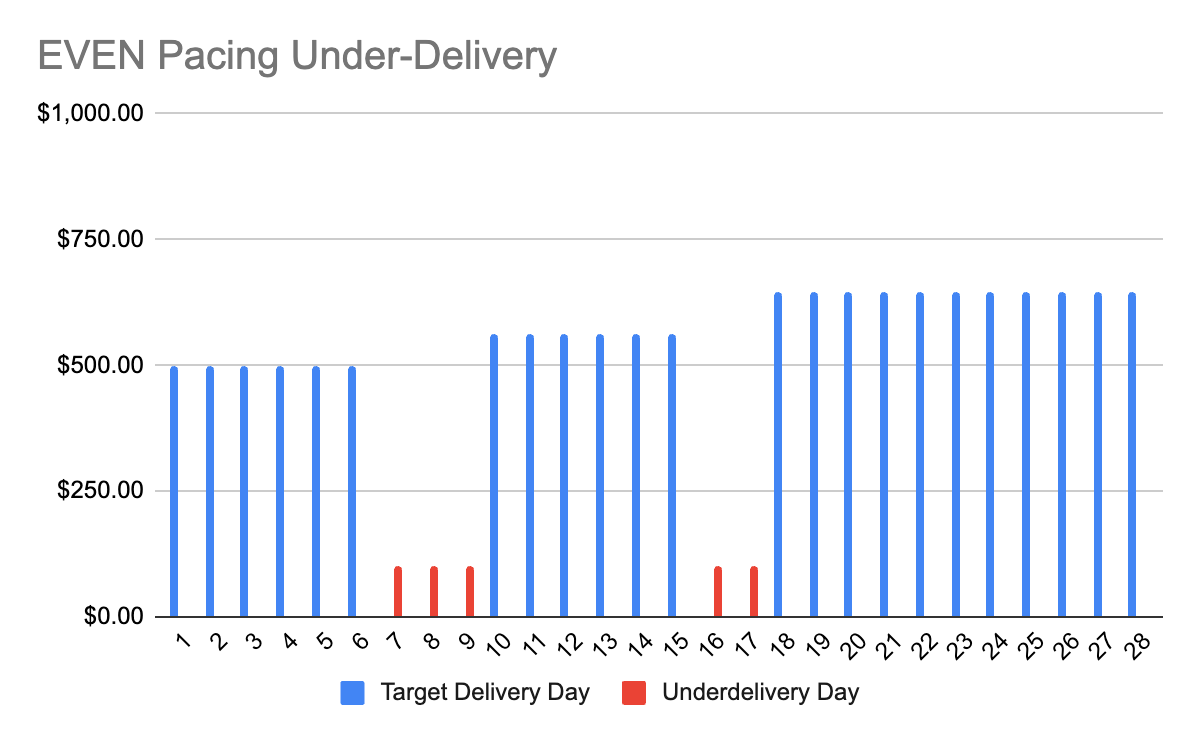
- Days 1-6: Normal, even daily delivery ($500 per day).
- Days 7-9: $100 under-delivery.
- Days 10 - 15: Normal, even daily delivery - adjusted to $563 per day ($1300 under-delivery distributed across the remaining 19 days).
- Days 16-17: $100 under-delivery once again.
- Days 18-28: Normal, even daily delivery - adjusted to $647 per day.
EVEN_ASAP_CATCHUP (Default)
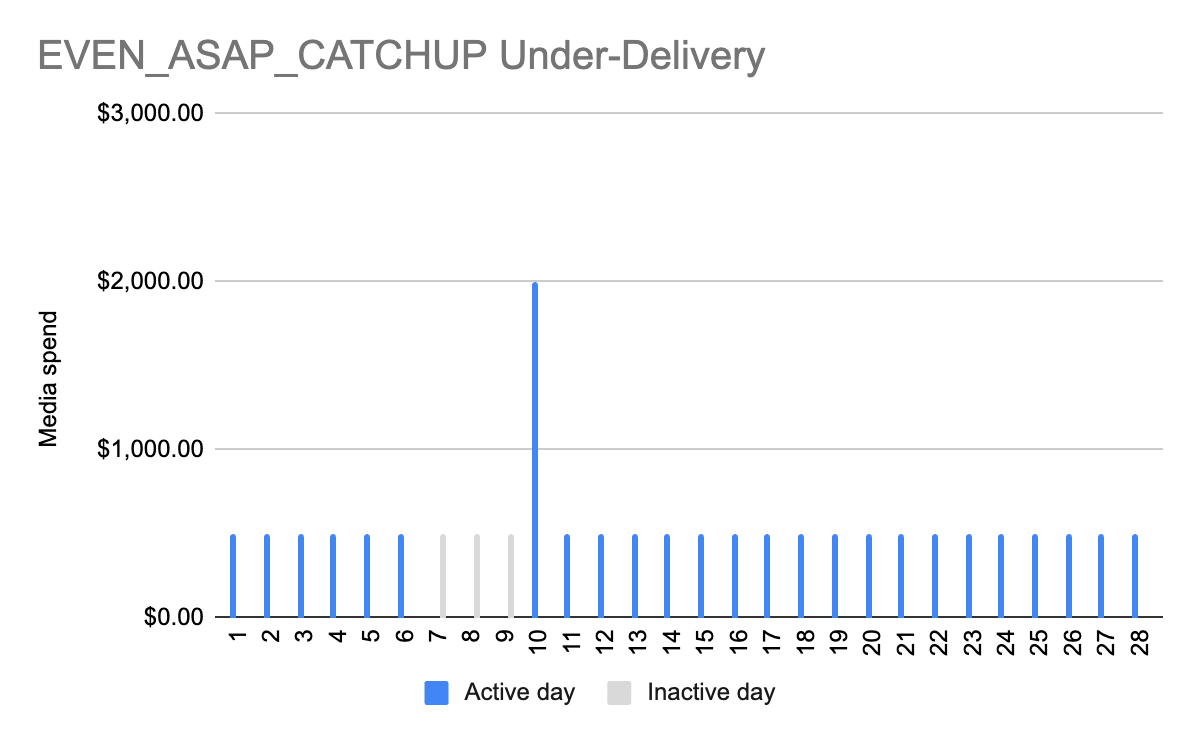
- Days 1-6: Normal, even daily delivery ($500 per day).
- Days 7-9: 0 delivery.
- Day 10: 4x normal daily delivery ($2,000) to catch up.
- Days 11-28: Normal, even daily delivery ($500 per day).
To smooth delivery in such a scenario, publishers apply a daily cap. Using EVEN pacing with a daily cap set at 2x the normal delivery (a $1,000 cap) produces the following result:
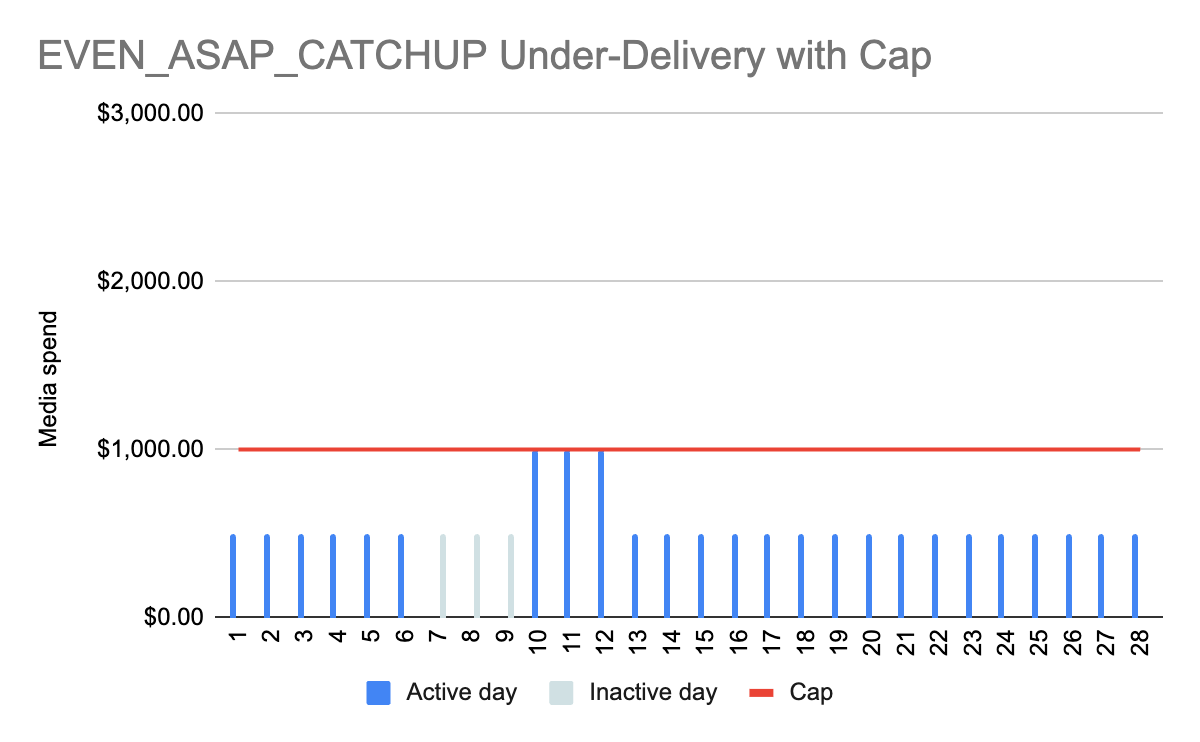
- Days 1-6: Normal, even daily delivery ($500 per day).
- Days 7-9: 0 delivery.
- Days 10, 11, and 12: 2x normal delivery ($1,000 per day).
- Days 13-28: Normal, even daily delivery ($500 per day).
Placement Over-Delivery
When a campaign experiences over-delivery during a 4-week flight, the EVEN pacing strategy behaves as follows:
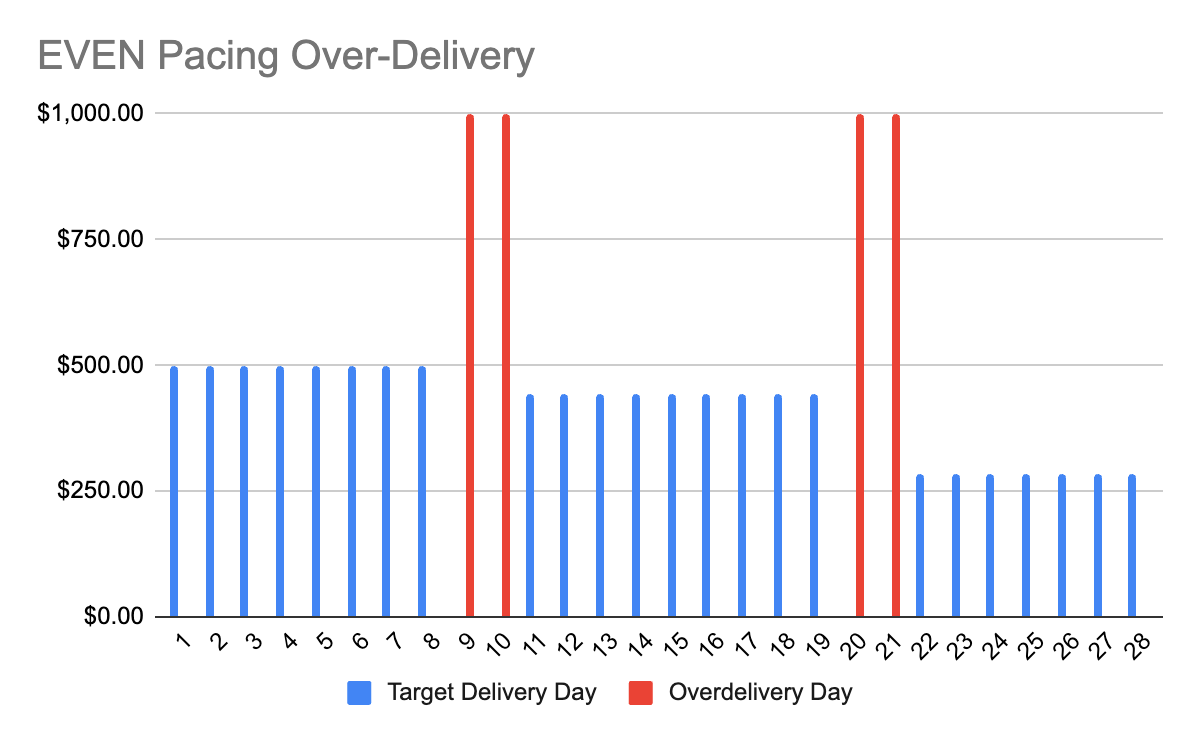
- Days 1-8: Normal, even daily delivery ($500 per day).
- Days 9-10: over-delivery ($1000 per day).
- Days 11-19: Normal, even daily delivery - adjusted to $444 per day ($1000 over-delivery distributed across remaining 18 days).
- Days 20-21: over-delivery ($1000 per day).
- Days 22-28: Normal, even daily delivery (adjusted to $285 per day).
ASAP Pacing
When inventory availability fluctuates significantly, using the ASAP pacing combined with daily caps may yield better results than using the EVEN pacing.
If a campaign is severely under-delivering due to inventory availability, consider loosening or removing daily caps and using the ASAP pacing to accelerate spending and catch up.
| Deal Type | System Behavior |
|---|---|
| PG | The seller controls pacing. The DSP is expected to bid on at least 95% of available inventory, provided the campaign has an available budget. |
| PMP |
The DSP controls budgeting and pacing, typically distributing spend across the campaign's lifetime based on its internal strategies, which can vary. Warning: Implementing Place Exchange budgets and pacing controls without knowledge of the DSP's campaign settings may result in campaign under-delivery. |
